Make sure you need a receiver
A receiver takes wireless audio from a source such as a phone and provides an output to the stereo. A transmitter performs the opposite job. Some products offer both modes, but the selected mode and supported connections still matter. A device advertised for sending television sound to headphones may not be the right accessory for adding phone playback to an amplifier.
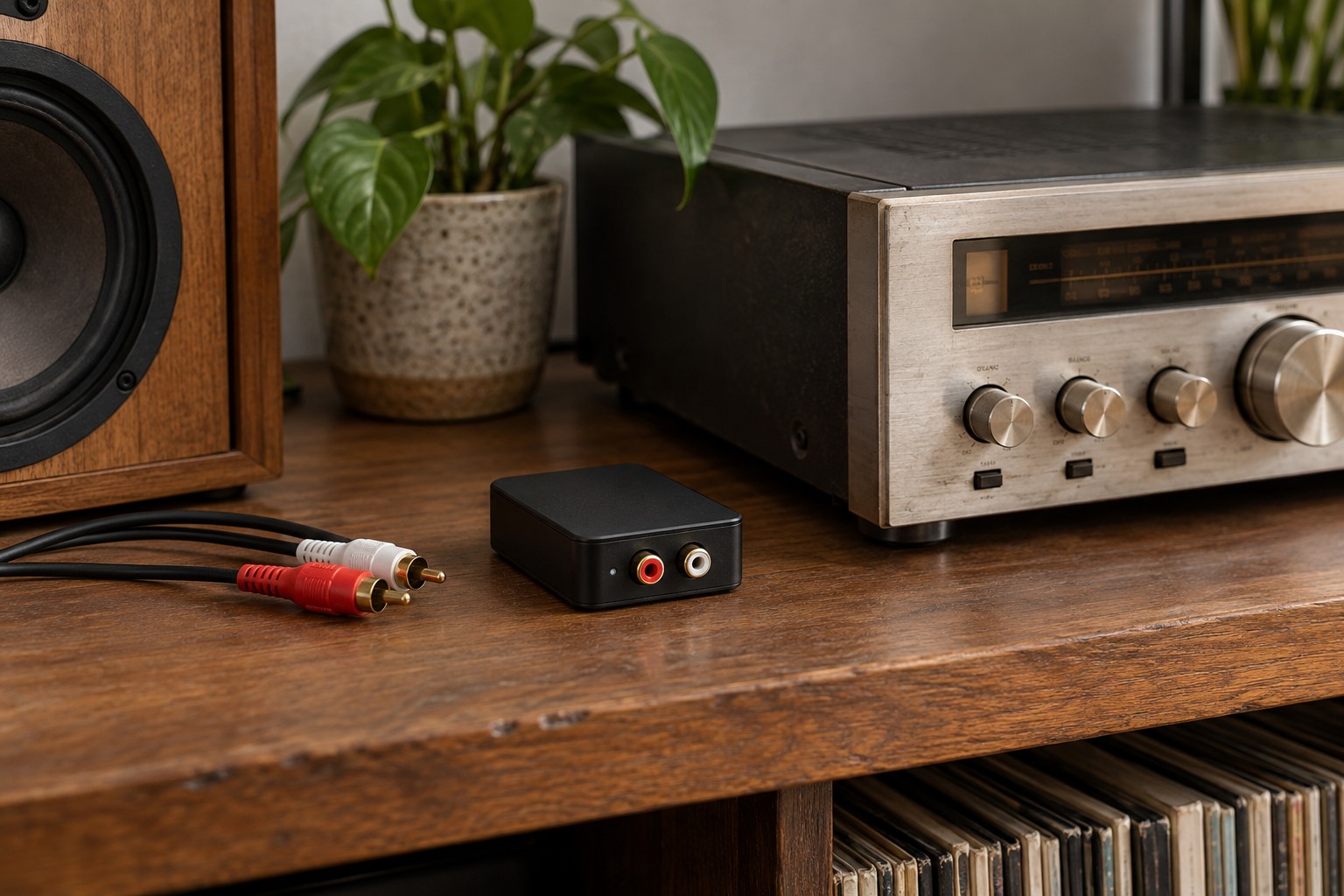
Inspect the stereo for a spare line-level input such as AUX. Do not use a phono input for an ordinary receiver’s analog line output. If the stereo has only a digital input available, the receiver needs a compatible digital output and format. Photograph the rear panel and write down the input label before shopping.
Include power and volume control
Check how the receiver is powered and whether its adapter is supplied. A USB socket on nearby equipment should not be assumed suitable without checking its purpose and power specification. Place the receiver where its cables can reach without pulling and where pairing controls remain accessible.
Find out whether the analog output is fixed or variable and how phone volume interacts with it. Begin with the stereo volume low, then establish a repeatable operating arrangement using the manufacturer’s instructions. A remembered high phone volume can produce an unexpected change when switching from another source, so test transitions deliberately.
Try reconnecting, not just pairing
Pair the intended phone, play music, then disconnect and reconnect after turning the system off and on. Check whether the receiver automatically chooses a previously connected device. In a shared household, this can be convenient or confusing depending on whose phone is nearby. Confirm how to remove old pairings and whether the device can remember more than one source.
Test the normal listening position rather than judging range beside the receiver. Walls, furniture, and the source location can affect the connection. Keep expectations specific: this adds a wireless input, but does not turn passive speakers into a wireless pair or create synchronized multiroom playback. If it handles the source switch reliably and fits the existing input arrangement, it has solved the intended problem.