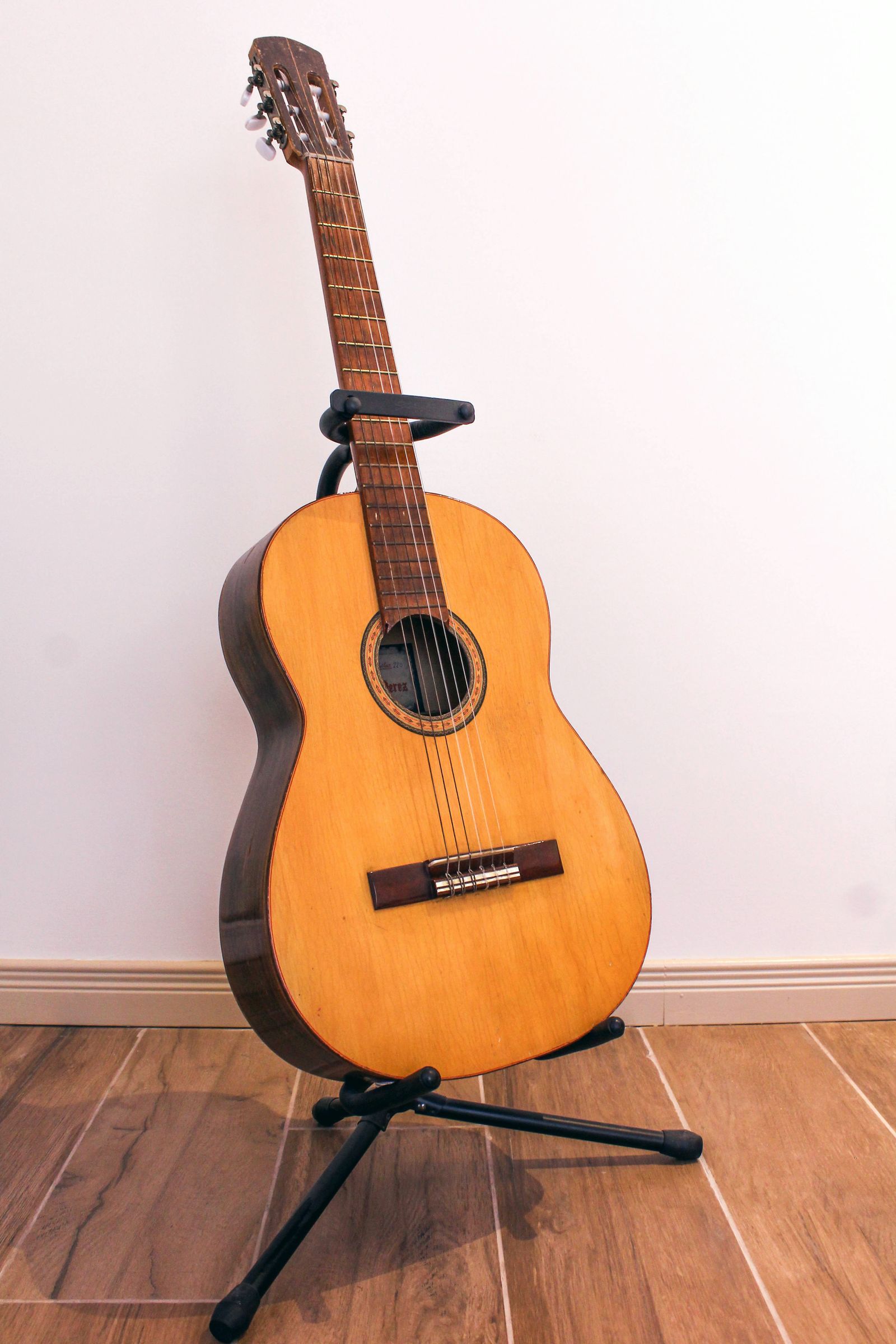
Hold the instrument before choosing the label
Sit with the ukulele in the position you intend to practice. Check whether it stays stable while the fretting hand moves, rather than requiring that hand to grip the neck constantly. A very small body can be easy to carry but less convenient to hold for some players. A larger one can provide a different resting position without automatically being more comfortable.
Try a simple chord and a short movement between frets. Larger sizes often provide more room along the neck, but actual neck width and profile vary by model. Compare the spacing with your own fingers instead of assuming that a particular size is reserved for children or adults.
Check the tuning used by your lessons
Common soprano, concert and tenor tuning is gCEA, while baritone commonly uses DGBE. That difference affects how chord diagrams relate to sounding pitches. If you are following a course, confirm which tuning it assumes before buying. A baritone is not merely a larger version that always uses the same lesson instructions unchanged.
There are alternative tunings and string arrangements, but they require appropriate strings and instrument guidance. For a first purchase, it is usually clearer to start with the maker's normal configuration and learn what it does. Avoid asking a shop to force an unsuitable string set into a tuning simply to match an online video.
Compare the complete practice setup
Play or ask for the same short pattern on the shortlisted instruments at a similar level. Listen for the balance you prefer, but also notice whether the body moves when you strum. If a strap is part of the solution, verify the instrument's attachment arrangement and choose a method approved for that model.
Check the case or bag dimensions separately. A long-neck or unusual-body model may not fit a generic bag labeled only by the broad size family. Include a compatible tuner and a spare string set in the purchase plan, and keep the string specification with the instrument details.
Choose the size that works for your intended music and everyday handling. It is entirely reasonable to prefer a smaller instrument for portability or a larger one for spacing. The decision becomes easier when tuning compatibility and physical fit are tested rather than guessed from a product photograph.